DIVERTIMENTO
Divertimento 1
You can track the first Brazilian satellite, SCD1, on the internet in real time. Go to http://www.n2yo.com/?s=22490 and follow the spacacraft as it moves along its nearly circular low-inclination orbit around the Earth at an average altitude of about 750km.
You can likewise track SCD2 at http://www.n2yo.com/?s=25504. The two satellites have very similar orbital parameters, including an orbital period of almost exactly 100 minutes.
SCD1 was launched on February 9, 1993, and SCD2 was launched on October 23, 1998. Both satellites were designed, developed, and built in Brazil, and both remain in operation to this date, relaying environmental data collected on the ground by automatic DCPs to tracking stations located in Cuiabá, MT, and Alcântara, MA.
SCD1 is currently the oldest artificial satellite in continuous operation in Earth orbit since its launch.
How about tracking a remote-sensing satellite in a high-inclination (polar) orbit? The fourth Chinese-Brazilian Earth Resources Satellite, CBERS4, can be followed at http://www.n2yo.com/?s=40336. The most recent satellite of this binational series, CBERS4A, launched in December, 2019, is found at https://heavens-above.com/orbit.aspx?satid=44883&lat=0&lng=0&loc=Unspecified&alt=0&tz=UCT.
And here is the link for Amazonia-1 http://www.n2yo.com/?s=47699, the first entirely Brazilian remote sensing satellite, launched on February 28, 2021. Notwithstanding its name, Amazonia-1 is also in a polar orbit and can make images of any place on Earth.
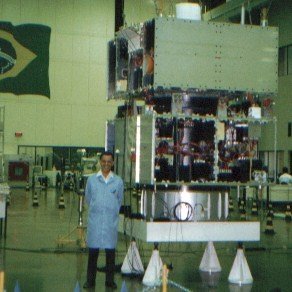
Shown in the photo below is part of a model of one of the first satellites of the CBERS Program assembled for tests at INPE's Integration and Testing Laboratory (LIT) in São José dos Campos.
Você pode acompanhar em tempo real os dois satélites brasileiros de coleta de dados ambientais em suas trajetórias ao redor da Terra clicando em http://www.n2yo.com/?s=22490 para o SCD1 e em http://www.n2yo.com/?s=25504 para o SCD2. Ambos foram inteiramente projetados, desenvolvidos, construídos e testados no Brasil há mais de trinta anos. Lançados em 1993 e 1998, respectivamente, continuam funcionando em órbita até hoje. (Recentemente o SCD1 tornou-se o mais antigo satélite artificial da Terra em funcionamento ininterrupto desde o lançamento.) Como a inclinação das órbitas desses satélites em relação ao plano do equador é de 25 graus, eles não sobrevoam locais com latitude maior que 25 graus; mas podem "enxergar" um pouco mais além, graças à altitude das órbitas. Costumo dizer que os SCDs são "satélites tropicais".
Da mesma forma, você pode acompanhar em http://www.n2yo.com/?s=40336 a trajetória do CBERS4, o quarto satélite sino-brasileiro de observação da Terra (sensoreamento remoto), de órbita quase-polar, lançado em dezembro de 2014, que sobrevoa pontos desde o equador até as vizinhanças dos polos (sua cobertura é global). O mais recente satélite desta série, o CBERS4A, lançado em dezembro de 2019, encontra-se em https://heavens-above.com/orbit.aspx?satid=44883&lat=0&lng=0&loc=Unspecified&alt=0&tz=UCT .
E aqui está o Amazônia-1 http://www.n2yo.com/?s=47699 , o primeiro satélite de sensoreamento remoto inteiramente brasileiro, lançado a 28 de fevereiro de 2021. A despeito do seu nome, o Amazônia-1 também está em órbita polar e pode imagear qualquer ponto da Terra.
A foto acima mostra parte de um modelo de um dos primeiros satélites do Programa CBERS montado para testes no Laboratório de Integração e Testes (LIT) do INPE em São José dos Campos.
Divertimento 2
A geostationary satellite appears fixed in the sky because it goes around the Earth on a circular equatorial orbit in exactly one sidereal day (T=23h56min4.1sec). The radius of that unique orbit is R=42164km, the constant speed is V=3074.6m/s, and the centripetal acceleration (V2/R) caused by gravity equals GM/R2, where G is Newton's constant and M is the mass of the Earth.
Similarly, a satellite of Mars that will appear fixed in the sky to an observer on the surface of that planet must be placed in equatorial orbit at a precise altitude and velocity. Can you determine the radius of the unique ares-stationary satellite orbit? As you know, the Martian sidereal day is slightly longer than ours (24h37min22.7sec) and the mass of Mars is rather small, only 0.10745 of the mass of the Earth.
Indeed, it should be possible to launch and stationkeep and operate stationary satellites around Mars! Yet, after you compute their altitude, you may wonder if gravitational perturbations by Deimos and Phobos will be a serious concern. Should that be a cause for fear of spacecraft loss?
On the same subject, do you think it is possible to place stationary satellites around Mercury, Venus, or our Moon? Why not?
------
Um satélite geoestacionário aparece "parado" no céu porque dá uma volta em torno da Terra em órbita circular equatorial em exatamente um dia sideral (T=86164,1seg). O raio da órbita é R=42164km.
Um satélite aresestacionário fará a mesma coisa em órbita em torno do planeta Marte (cujo nome em grego é Ares).
Exercício: Sabendo que o dia sideral de Marte é um pouquinho mais longo (T=88642,7seg) e a massa de Marte é apenas 10,745% da massa da Terra, calcule o raio da órbita dos futuros satélites aresestacionários.
Dica: Há proporcionalidade envolvendo as massas, os quadrados dos períodos e os cubos dos raios das órbitas (João Kepler).
Divertimento 3
This is a mathematical divertissement with prime numbers.
The following are the smallest prime numbers that, when written in binary digits, are made up of 1s only (no 0s):
11 (=3) 111 (=7) 11111 (=31) 1111111 (=127)
These numbers are known as Mersenne primes. Clearly, each is a power of 2 minus 1: 3=4-1, 7=8-1, 31=32-1, and so on. By the way, most numbers of this form, such as 1111 (=15), are not prime.
It is conjectured, but has never been proved, that the sequence of all Mersenne primes is infinite. In other words, people believe that there is no largest prime number of this form.
Now consider the infinite sequence of all odd numbers that are written in binary with alternating 0s and 1s. It begins as follows:
1 (=1) 101 (=5) 10101 (=21) 1010101 (=85) 101010101 (=341)
10101010101 (=1365) 1010101010101 (=5461)
101010101010101 (=21845) 10101010101010101 (=87381) ...
None of the nine numbers above, except 101, is prime. (As you know, 1 is not considered to be prime, it is hors concours...)
Is 101 (=5) the only prime number in this infinite sequence? If so, can you prove it? If not, what is the next prime in the sequence?
If you are convinced that 5 is not alone, is there a largest prime number (larger than 5) that is made up of alternating 0s and 1s? Or is there an interminable (infinite) list of primes made up of alternating 0s and 1s?
Note: The above questions were first posted here more than seven years ago, and I have not yet received a correct answer. Nobody has sent me an example of a prime number of the 1010...10101 class that is greater than five. (Hint: It would have to be a huge number, a number with more than one hundred decimal digits.) And nobody has sent me a valid proof that no such prime number exists. Is the answer known? Or, do we have an open problem in mathematics?
Divertimento 4
On Neutrino Mass Possibilities
Questions, not Answers
by A. B. Carleial
10 May 2008
(with an addendum of 10 December 2011 and minor editorial changes done in 2019)
So their rest mass is not zero?
Many years ago, when I first heard of neutrinos, everybody talked of them as ghostly chunks of nothing that, like photons, had no rest mass or electric charge and moved with the speed of light, carrying momentum and energy, but, unlike photons, had a very hard time interacting with anything.
Several years ago I began hearing that neutrinos have mass. As of now, we are told it is no longer disputed that they have mass. Neutrinos have non-zero rest mass.
They are not all the same
There are neutrinos and antineutrinos, of course, but this is not all.
For many years now it has been known that there are three types of neutrinos: the electron neutrino, the muon neutrino, and the tau neutrino. They are named after their corresponding charged leptons (the electron, the muon, and the tau). You may refer to neutrino types as “flavors” if you have a taste for them.
As for their chirality, all neutrinos are left-handed and (you guessed it!) all antineutrinos are right-handed. I find this pretty odd.
Getting used to neutrinos
I am a conservative sort of person. For instance, when I was told that the decay of Z bosons dictates that there can be no more than three types of neutrino, I felt content. We had them all in the bag: the e, the mu, and the tau! Yet some people now say other neutrinos may exist that have some special quality (“sterility”, what else?) that renders the Z boson decay constraint irrelevant for them.
People have a fertile mind. I say to them: Please give me a break! It has taken me quite a while to get used to regular neutrinos in the first place.
The question of mass (1)
As I said, it took me a while to get used to neutrinos. But in due course I even came to like them. I came to like them as I thought they were: having no electric charge, no mass, and only the weakest disposition to interact.
Now we are told that there is compelling evidence of “oscillations” between neutrino types which imply that their mass differences cannot be zero. In other words, their masses (more precisely, their three eigenvalue mass states) must be different from each other. Therefore, they cannot all be zero.
The question of mass (2)
Suddenly people are happy because, among other things, neutrino oscillations provide an explanation to the long-standing mystery of fewer solar neutrinos being detected here on Earth than expected. I am happy for that, too.
But I am unhappy that while their non-zero masses have to be tiny, as current upper bounds demand, no credible lower bounds seem to exist. I am uncomfortable with the absence of a significant time lag between photons and the supposedly massive neutrinos from supernova 1987A on their very long flight to Earth.
The question of mass (3)
The well-known masses of the electron, muon, and tau increase in this order. From what I have read, it appears that the minuscule mass states of their corresponding neutrinos ought to increase in the same order, but, alas, an inverted order cannot be ruled out.
Conservative as I am, it has occurred to me that perhaps the smallest neutrino mass state could be zero, after all, with the other two being different positive mass states! Is this possible? If you know the answer, please let me know.
And now the speed of neutrinos is in question!
This is a small 10 December 2011 addendum to my thoughts of 10 May 2008.
Recent experiments appear to have detected muon neutrinos traveling faster than light! I have no idea of what new theory people will come up with in order to explain this finding if (against my expectation) it can be confirmed.
For now I am having a little fun saying that things may be easier to explain if one admits that in the relativistic equations the mass of the muon neutrino is imaginary…
(Editorial note: In 2012, a few months after this addendum was written, it was finally determined that imperfect equipment used in the OPERA experiments had caused the neutrino speed measurements to be in error.)